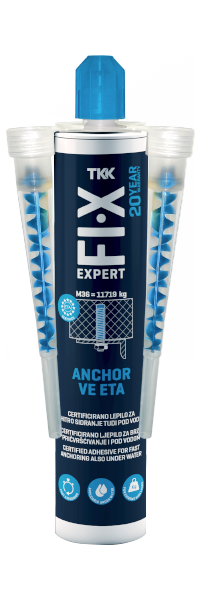
ETA certified for two-component vinyl ester chemical anchoring adhesive, threaded rods, dowels, anchors, fittings, etc. for anchoring elements Suitable for cracked or uncracked building materials, such as concrete, bricks, aerated concrete, stone, etc.
Characteristics: Very strong adhesive with a 50-year anchor life. High compressive strength, therefore withstands heavy loads. For indoor and outdoor use. Almost odorless. Applicable for interior and exterior works. Useful in wet and humid environments. It creates a waterproof barrier. Good chemical resistance. Fast curing. Does not drip, can be used over the head. Suitable for cracked or uncracked concrete, wood or other high strength materials. Useful for any size of threaded rod or rebar, even small diameter. Little shrinkage during curing, so the adhesive is suitable for filling larger holes. VOC content: A+ class. Fireproof glue (R240). Temperature resistant from -40 °C to 80 °C
Purpose: High load resistance for chemical anchoring of threaded rods, dowels, anchors, rebars, rebars in concrete, bricks, stone, etc. where a European certificate is required. Useful even at low temperatures up to -10 °C, store the cartridge at 20 °C. Suitable for wet and dry concrete. Also suitable for places where drinking water is used. Suitable for materials that are permanently under water. Temperature resistant from -40 °C to 80 °C. Complete hardening in 24h.
Application: Mortar and concrete must be at least 28 days old. The bore should not be greasy and should be thoroughly brushed and blown with air. Unscrew the cap, peel off the foil from the cartridge, cut it off at the thread of the cartridge. Screw on the static mixer, firmly attached to the cartridge. Make sure both ingredients are in a static mixer. Load the cartridge into the gun. The glue is well mixed if it is a uniform gray color. The first 10 cm of mass must not be used for anchoring. Fill the hole from the bottom up. Fill approx. 2/3 of the hole, but the entire space between the wall and the anchor must be filled to its full depth. Make sure the anchor is dry and clean. The anchor is pressed into the filled hole by slowly turning it, and the glue should flow from the sides of the hole. During curing, the anchor must not be moved or loaded.
Manufacturer: TKK d.o.o. Slovenia