The second half of winter is the right time to restore the liming of fruit trees. But what if you haven’t been able to do it yet? Edgars Rubauskis, the leading researcher of the Latvian State Fruit Growing Institute, believes that liming in spring has only a decorative or work-feeling effect, because the sun will have already done its devastating work. What exactly does sunlight do to trees in the second half of winter, and how to deal with it?
Sun in the second half of winter
In the second half of winter, when the air temperature remains low, the sky is much clearer and the sun shines. During the day, the surface parts of plants heat up under the influence of solar heat, but in the evenings and at night, when the air temperature drops below zero, it cools down rapidly. As spring approaches, sharp temperature fluctuations create unfavorable conditions for plants. Under the influence of these conditions, the plants are threatened by physiological drought, sunburn, which results in bark cracking.
Bark lesions
Bark damage – bark peelings and cracks, in winter the bark cools faster than wood. As it cools, the bark shrinks faster, so it tears and breaks. Damaged areas (even microcracks) are a lavish environment to inhabit pathogens – bacteria, pathogenic fungi and pests. Trunk lesions contribute to the development of rot, tanning and cancer.
Young trees and tree species with thin bark, especially all fruit trees, must be protected from bark cracking. Ornamental trees are protected from sunlight by shading with spruce, pine branches, agrofilm, etc. breathable materials or wrapping of a tree trunk with straw, reeds, old fabrics, papers, cloth bags, pine or spruce branches. It is best to wrap tree trunks in November. This will protect the trees not only from the frost, but also from rodents. The best time for shading is the end of January – the beginning of February.
Liming of fruit trees
To protect the trunks of fruit trees, modern methods and materials are now often used – special pipes, sieves or nets designed to protect young trees and shrubs from frost and rodents, or covering the trunks with reeds, spruce branches. However, a well-known and more traditional method of bleaching or liming the trunks of fruit trees is still used.

Liming
Liming should be done in late autumn (November, December after the onset of frost). In early spring you can restore the liming layer on the trunk. Later, this work has only a decorative or work-like effect, because the sun will have already done its destructive work. Liming is done in dry weather, preferably in the middle of a sunny day. The main thing is that at that moment there is no precipitation and the trunks manage to dry out.
Lime all fruit trees, especially the weaker ones – apricots, sweet cherries, plums. Fruit trees on small rootstocks may not be limed, incl. in commercial gardens, as long as they are planted and designed so that the trees shade each other, and which are protected from the sun on the southwest side by a support.
It is possible to buy ready-made liming material in gardening stores, but you can also prepare it yourself. Chalk or lime emulsion is used for liming apple trees in the backyard garden. If there is concern about the spread of cancer or the orchard is quite large, the liming material is made from freshly slaked lime and copper vitriol. First, a lime emulsion is prepared by adding 2-3 kg of quicklime to 3l of water. After that, dissolve 300g of copper vitriol in a small amount of warm water and dilute it by adding another 7l of water. With constant stirring, the copper vitriol solution is poured with a small stream to the milk of lime (not the other way around!).
Before liming older fruit trees, carefully remove dead bark, moss and lichens from the trunks with a brush. This is best done in the fall after the leaves have fallen off, when the old bark has thawed in the rain. If there are any trunk lesions, they are cleaned and treated. The prepared liming mixture with a wide and thick brush is applied in several layers to the trunks, thicker branches at a height of one and a half meters above the ground. If a spray apparatus with nozzles (coarse drops) is used for bleaching, the bleaching shall be repeated several times so that the white layer is sufficiently thick and durable. Wear protective clothing, work gloves and a respirator when liming. If copper vitriol is added to the mixture, special care must be taken as it is toxic.
Liming of fruit trees, especially when copper vitriol is added to the liming mixture, provides:
Reduces burns,
Prevents pathogens from entering the bark,
Limit the spread of pests;
Prevents moss, lichen growth on trunks.
However, if you have not been able to take measures to protect the trunks of the trees, and damage caused by sunburn is detected, the bark is spotted, these wounds must not be allowed to dry on the trunk. Potwax can be used for this purpose. If you want to protect the trunks from cancer and sun damage, you can treat the wounds with leran before applying the wax. Such wounds and loose bark must not be allowed to dry out, otherwise the damage will be irreversible.
Advised LVAI leading researcher Edgars Rubauskis
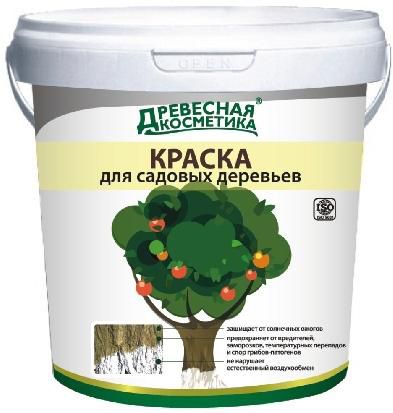
To protect the garden trees from sunburn and pests, a special paint was developed «Paint for garden trees» from the series «Wood cosmetics»
The paint easily adheres to the wooden surface and forms a breathable coating, protects against insects – pests, sunburn and the harmful effects of low temperatures, does not affect natural air exchange.
The paint for garden trees is so simple and easy to use that any beginner in gardening will be able to cope with the liming process, it is enough to mix and apply with a brush or sprayer on average up to one meter above the ground, after 24 hours the paint will be completely dry.